The biggest obstacle facing independent musicians today isn’t making music — it’s getting people to hear it.
Every single day, thousands of songs are added to streaming services. Still, without strong production and songwriting, tracks tend to be buried in an endless stream of releases. The algorithms tend to reward artists who have already built up traction, which makes it hard for newcomers to be discovered.
The consequence of this; many gifted musicians have a vicious cycle: great music, limited exposure.
And that’s why the music industry is starting to reconsider how artists can reach their listeners beyond conventional streaming.
Beyond Streaming: Real-World Audio Distribution
Discovering music doesn’t always take place in the apps or playlists. In fact, some of the most memorable songs people hear come as a surprise — in malls, cafés, retail stores, gyms or while commuting.
And this is where real-world audio distribution gets interesting.
Rather than waiting for listeners to go searching for a track, distributed audio networks integrate music into quotidian spaces. And they create an even blunter listening experience as audiences are likely to absorb the music passively while remaining immersed in their routines regarding these spaces.
The power of in-store and ambient audio in capturing an audience, setting a mood, and influencing behaviour is already well established within the retail experience. Businesses are increasingly adopting curated music systems that provide a holistic experience and keep customers immersed.
For artists these environments represent a new channel for discovery.
How Low Mic Scales Artist Reach
Low Mic corral this idea by distributing music onto large public audio networks. With partnerships around the world, artists’ tracks can now be played on spaces like malls, retail environments and transit areas, where thousands of feet walk through on a daily basis.
This type of distribution greatly increases visibility.
Existing platforms that center on in-store and ambient audio have shown how music can, quite literally, be listened to everywhere from tens of thousands of locations across hundreds of cities, exposing tracks to millions more listeners than they’d receive on digital services.
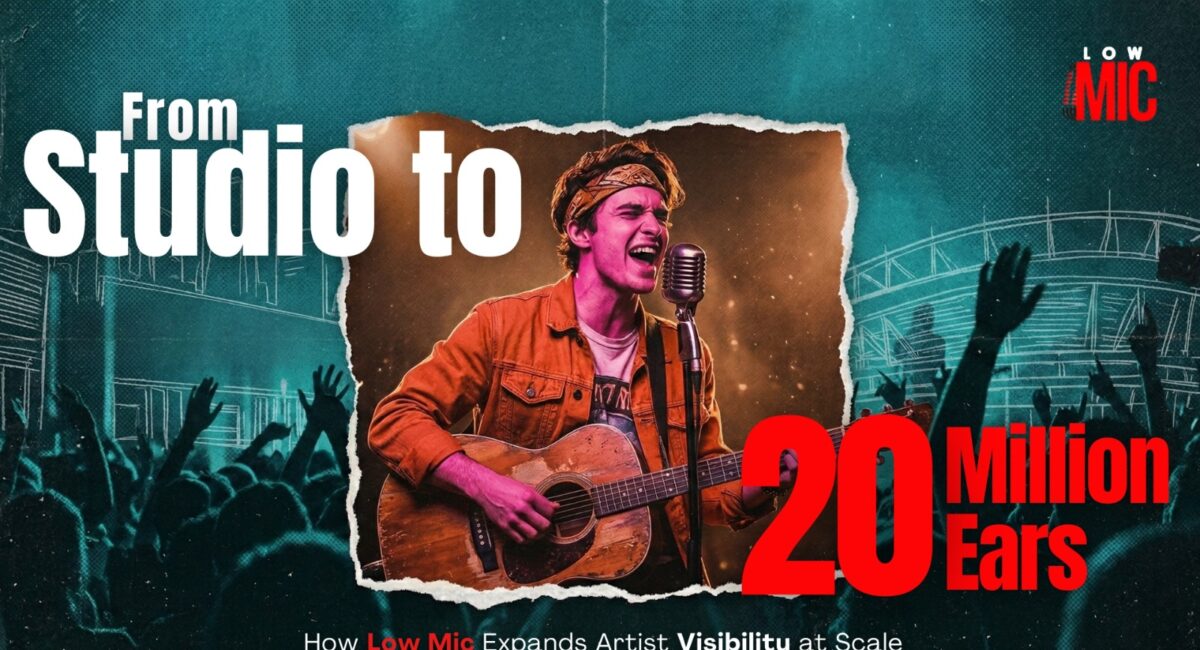
For Low Mic artists, that means access to a vast captive audience — as many as 20 million listeners a day.
Whereas streaming requires a listener to actively seek out a track, this model allows for discovery to occur passively. The music plays organically during shopping, commuting or exercising.
Why Captive Audio Audiences Matter
Captive listening environments are a whole different ball game when it comes to engagement.
Attention in social media feeds is measured in seconds before someone scrolls away. But music keeps playing in physical spaces. You hear it over and over again throughout the time you are in the space.
That repetition is powerful.
A track heard while shopping can become ingrained over time, leading to subtle recognition that eventually manifests as streams, searches or social media follows.
That sort of exposure can be invaluable for independent artists.
Scale-up from Studio Track to Mass Awareness
All songs start out the same way: in a studio, with an idea and a microphone.
But getting that track to be something people recognize takes distribution, consistency and visibility.
Low Mic fills in that gap. By inserting music into real-life listening scenarios, artists can finally escape the confines of a streaming service and find an audience during actual daily life.
Slowly, a studio recording becomes something bigger — a sound people begin to hear in different places at different times.
A New Era of Music Discovery
Channels for the discovery of music will not be singular in future.
Streaming platforms will still be central, but artists also need more ways to get in front of listeners. Distributed audio networks — the kind that power platforms like Low Mic — are a whole new frontier for music exposure.
When music is not confined to headphones but is in the places where people live, shop and travel, discovery feels much more organic.
And for independent artists seeking to be heard, that pivot could come to redefine how the next generation of music gets out into the world.