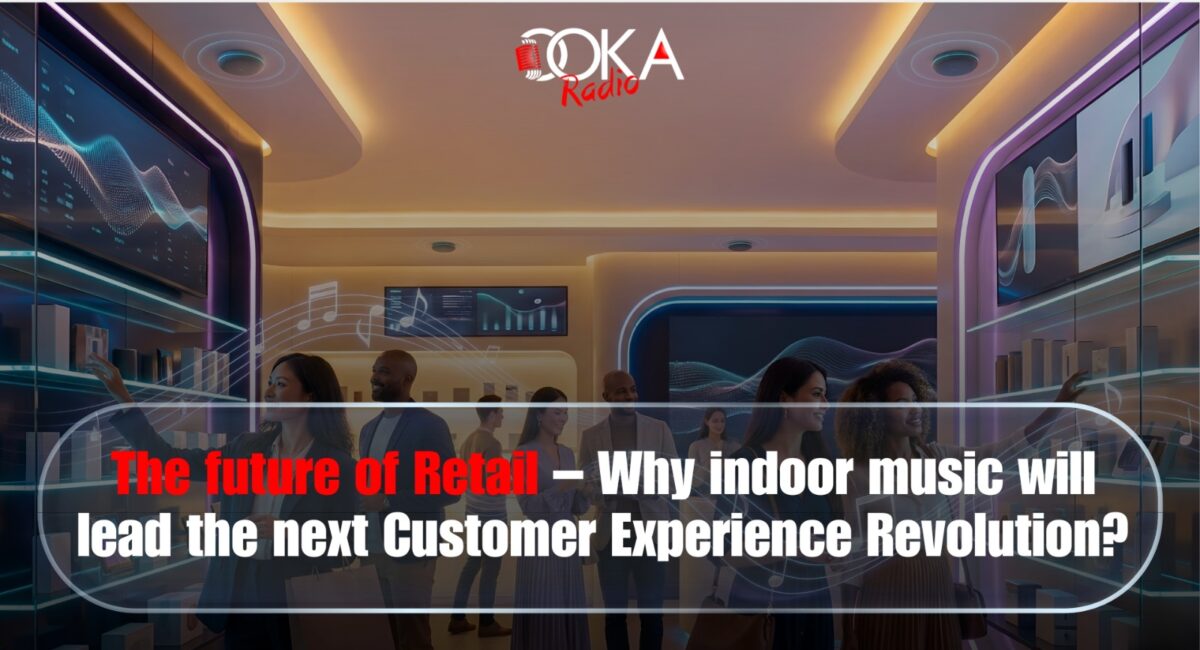
Retail is a rapidly changing game and most brands are finding it hard to keep up with it. Footfall patterns, shopper expectations, and competitive pressure are changing every quarter. However, one thing that is quietly becoming the next biggest customer experience factor is indoor music. Retailers, who use music as a strategic instrument not as a background filler, are already experiencing higher dwell times, stronger conversions, and clearer brand recall. This is not a trend. It is the next operational advantage that modern retail will rely on.
Why customer experience is the battleground now
Shopping online has made buying very easy and without any problems. Physical retail has to prove its necessity by giving experiences that seem more valuable than online shopping. Modern shoppers evaluate stores not only by the products but also by the atmosphere. Good lighting, well-designed layout, nice smell, and friendly staff interactions are what really count. Music is at the core of it because it regulates the energy, helps shaping the mood, and even dictates the time customers will spend in the store.
Retailers, who neglect this, treat customer experience as a mere cost. Retailers, who put this first, treat it as a powerful growth engine.
Why inconsistent or poorly chosen music destroys brand experience
Most stores still do the same mistakes over and over again:
- Playlists with random songs played by the staff
- Different sound environments at different locations
- Music being too loud or too soft
- No connection between brand identity and audio identity
- Zero timing strategy for peak and off-peak hours
The end is quite predictable. Customers enter a brand but do not experience the brand. A luxury store that offers generic pop kills its own positioning. A youth brand that plays slow music loses its energy. A supermarket that plays high-tempo tracks during the most crowded hours raises stress levels.
When In-store music changes unpredictably, the brand experience feels disconnected. In competitive retail environments, even small inconsistencies can lead to customer drop-off.
Indoor music as a controlled sensory strategy
Music influences brain faster than any visuals. Neuroscience research always points out that rhythm and tempo totally influence measurement of time, perception of value, and emotional comfort. Retailers can do this with extreme accuracy. For instance:
- Slow tempo leads to long dwell time in fashion and lifestyle stores
- Medium tempo with clear vocals helps browsing pace in bookstores and tech shops
- High energy tracks raise conversion during promotional events
- Warm acoustic tones increase perceived premium value
The strategic opportunity is straightforward. Once music is considered as an operational tool, it is a means to influence customer behavior on a large scale.
Why central control of music is now essential
Brands that operate across multiple locations have a serious problem regarding the execution of their plans. Even perfect guidelines are not very effective when each store independently manages its audio. Centralized music control is the solution for this problem. It helps a brand to decide on playlists, time slots, volume levels, and store-specific schedules all from one system.
Central control is the main reason for consistency. Every outlet feels like the same brand. Every customer experiences the brand’s customer journey. In fact, corporate teams can change audio strategy on the spot depending on traffic, season, or campaign goals.
This degree of accuracy was not possible ten years ago. Today it is the minimum requirement for a retail experience that can be scaled.
Data driven music is the next retail advantage
Smart audio systems can be integrated with analytics. So the music can be changed in response to the real situation inside a shop.
Examples of what data-driven systems can do:
- Change the tempo to be faster when footfall is high so that the movement is still smooth
- Reduce volume during the morning hours to correspond to the shopper’s mood
- Start playing the special playlist during the promotions
- Monitor the time that people spend in a place and test which playlist lead to higher conversion
- Change the audio based on weather, region, or festival periods
Retailers heavily invest in digital ads and CRM tools, yet they still manage to overlook an in-store factor that has a great influence on every customer for the whole duration of the visit. Data-driven music brings measurable outcomes without the need for more visual clutter or staff intervention.
How indoor music influences the bottom line
Indoor music is directly responsible for a few financial metrics that work together. These metrics include:
Longer dwell time
The customers are willing to stay a longer period of time in stores that have a musical selection which is either calming or well curated. The longer stay naturally results to more browsing and a higher average basket size.
Enhanced product perception
Premium brands are using slow, warm music to raise the perceived value of the product. This eventually results to a higher willingness to pay.
Increased staff productivity
By using balanced audio, stress is reduced and focus is improved. Therefore, the teams are able to work smoothly and serve better, which, in turn, increases customer satisfaction.
More impulse purchases
The right tempo will result in quicker movements in particular zones thus, unplanned buying will be on the rise.
Consistent brand recall
That time when customers link a predictable auditory identity to a brand is when their memory and loyalty towards that brand get stronger.
Improved crowd management
With music, rush hours can be made less hectic by “smoothing” them whereas empty hours become more “lively”. Both of these have a direct impact on operational flow.
Retailers who put money into the best possible audio solutions are witnessing growth because music is the main factor that influences experience at scale while
Why indoor music will drive the next experience revolution
Retailers have already been through the usual improvement ideas. Redesigning stores is costly. There staff training has its limits. Discounting eats away the margins. Visual campaigns are only noticed once. Music, on the other hand, influences the shopper’s emotions during every second of the shopping journey. It is the most powerful yet least utilized sensory channel.
The next wave of retail improvement will revolve around five shifts:
- Uniform audio identity for all the locations of a brand
- Music scheduling based on shopper behavior patterns
- AI-driven playlist optimization
- Integration with footfall and heatmap analytics
- Staff not having the manual audio control anymore
When these changes become the norm, physical retail environments will be perceived as more intentional, calm, and memorable. The experience gap between those stores that use strategically controlled music and those that don’t will become very large.
Practical steps retailers should take now
Any retail brand can position itself well for this transition by taking the following clear actions:
- Define the sound identity of the brand.
- Create playlists that are tailored and reflect customer segments.
- Establish rules for tempo, genres, and daily time-based scheduling.
- Implement centralized audio control in all the stores.
- Employ analytics to figure out which playlists lead to conversions.
- Eliminate manual control from local staff.
These steps help music to become an operational system for.