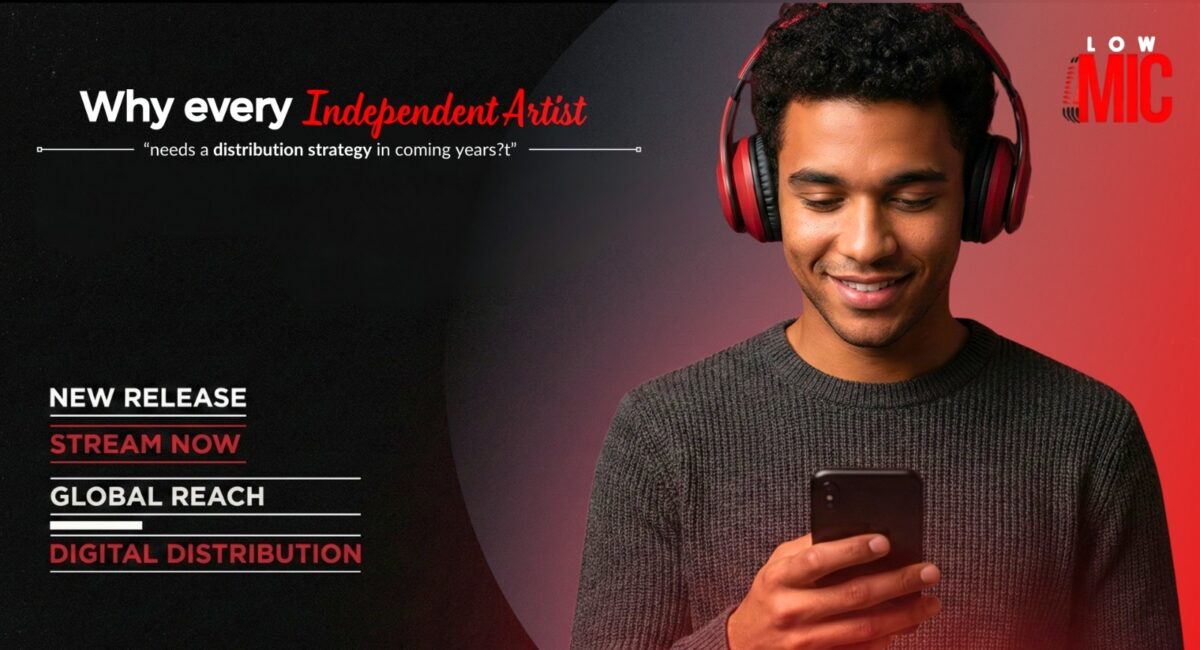
Talent without distribution is just unheard noise. Independent artists without a proper distribution strategy are doomed to fade away, regardless of how great their music is, within the next few years. The industry is not giving skill alone the reward anymore. Instead, it rewards visibility, consistency, and control. Any person who believes that good music will sell itself is completely unaware of the modern music ecosystem.
Distribution is no longer a backstage job. It’s the main business plan of an independent artist.
- The Music Market Is Overcrowded and Ruthless
In every month, millions of songs are being uploaded. More than 100,000 new tracks are submitted to Spotify daily. This means that your song is not only competing with the best, but it is also competing with everything else.
If you don’t have a distribution strategy, your music will just be another file on the platform and will die without anyone noticing. Algorithms do not hunt for talent. They simply respond to the existing trend. If your release doesn’t get an immediate boost by plays, saves, shares, and retention, it gets shelved.
Artists who put their trust in luck are not artists. They are gamblers.
- Platforms Do Not Promote You. They Test You.
Streaming platforms are not there for the artists’ benefit. They only promote content after testing it. Reviews from a small audience are the experiments. If those listeners don’t react enthusiastically, the platform withdraws the distribution.
A strategy guarantees that the first group of listeners is there on purpose. Fans, communities, mailing lists, WhatsApp groups, and social followers energize the first engagement. This is what signals the algorithms.
It is the same as releasing nothing if you put out music without thinking it.
- Social Media Has Become the Primary Distribution Layer
Currently, music is not first released on streaming apps, but rather on short video platforms. Reels, Shorts, TikTok, and YouTube are the new ways people discover music.
Artists that do not prepare for how the snippets, hooks, visuals, and stories will be shared on these platforms will lose their fans instantaneously. Randomly posting is not a strategy. It is perplexity.
A distribution plan figures out what to do with the song fragment, where to share it, how many times to repeat it, and who it is intended for.
Without this, even great songs seem to be nonexistent.
- Independent Artists Do Not Have Labels to Fix Mistakes
Labels are responsible for timing, rollout, playlists, press, and partnerships. Independent artists don’t have any of that safety net.
A bad release without a strategy is like throwing away months of work. Once a song has failed, it is very hard to bring it back. First impressions are of utmost importance.
A distribution strategy lessens the risk. It necessitates the release date, content schedule, audience targeting, and platform focus to be clear.
Artists who forgo this step normally blame the platforms when in fact they are blaming their own laziness.
- Ownership Requires Control Over Reach
One of the main points of independence is control. Control over rights, branding, audience, and communication. If you don’t have a distribution plan, then you just have music that no one is hearing.
An artist who wholly relies on one platform is a weak one. Accounts can be banned. Algorithms can be changed. Trends can shift.
A genuine plan not only broadens the artist’s reach across different platforms but also allows the artist to have direct connections via email lists, messaging communities, and websites. This is what provides stability in the long run.
Artists who refuse to see this will always be starting from zero.
- Audience Behavior Is Changing Fast
Today, people who listen to music are not the ones searching for artists. Artists are being presented to them. Thus, discovery is highly dependent on placement, repetition, and relevance.
Music is being consumed passively through playlists, videos for background, and social feeds. If you don’t make a point of getting your music into those spaces, then it is as if it doesn’t exist.
A distribution strategy is one that changes with the audience’s behavior instead of opposing it. It distributes music where the attention is already there.
Not taking this into consideration is being arrogant.
- Data Is the New Creative Tool
Distribution is the source of data. This data includes location, age, platform performance, skip rates, repeat listens, and more.
Artists that are vigilant about this data become more proficient in decision-making. They get to know where and in which language they should perform; they also know which songs resonate with the audience and which content is turning the listeners into fans.
Artists that neglect data put their trust in feelings. However, feelings cannot be scaled.
A strategy makes sure that data is gathered, looked into and used for the next work.
- Monetization Depends on Distribution
Streams, merch, live shows, brand deals, sync licensing, all of these are dependent on audience reach.
If there is no distribution, then there is no leverage. Brands are not interested in talent. They are interested in the amount of attention the talent gets. Venues, on the other hand, do not give spaces to unknown artists. Platforms do not pay those who are invisible.
A distribution strategy is what links music to money. Without it, independence is nothing but a form of unemployment with more steps.
- The Coming Years Will Be Harder, Not Easier
AI music, automated uploads, and content saturation, these are just some of the things that are going to massively increase the competition. To stand out will require you to have smarter release planning rather than putting more songs out.
The artists who have already grasped the concept of distribution will be the ones to carry on. The rest, those who disregard it, will be drowned out.
The future is going to be better for those who are able to operate their business well, rather than dream about it.
Conclusion
Each and every independent artist ought to have a distribution strategy simply because the industry is no longer the one that discovers talent. Instead, it filters the content.
Good music is taken for granted. Strategy is what makes the difference.
Artists who organize their distribution are the ones who have control over their growth. Those who disregard it remain invisible and angry.
In the near future, independence without a strategy will be a disadvantage rather than a freedom.
If you want people to listen to you, then you need to plan how you are going to be listened to. There is no other way but self-sabotage.